- Right now
- Closed now · opens ~8 am
- Usual hours
- about 8:00 AM – 6:00 PM
- Tickets
- ~₹10 Indian
~₹100 foreign - Distance
- ~18 km · 30 min
- Time needed
- 1–1.5 hours (2–3 hours with Khaba Fort)
- Best time
- Late afternoon, on the way to Sam
Updated 26 Sep 2026. Times and fees are approximate.
Highlights
- Roofless lanes
- Restored house
- Temple
- Paliwal legend
- Khaba Fort nearby
What Kuldhara is
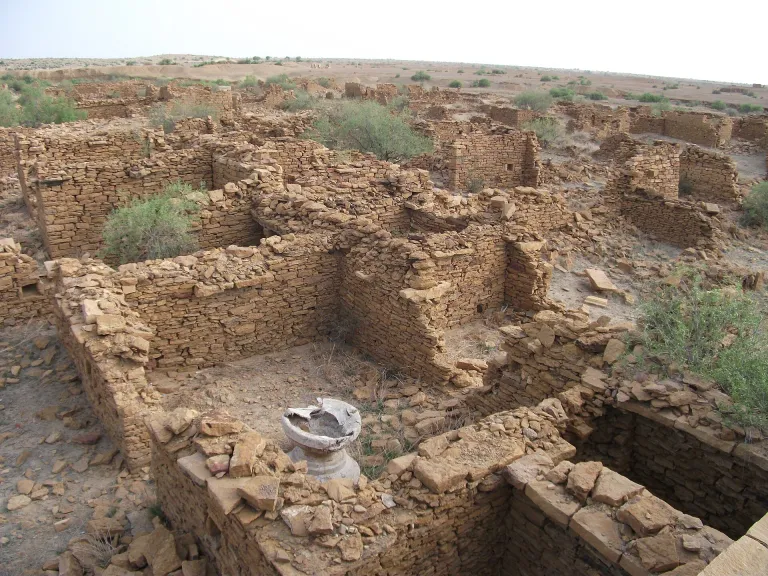
Kuldhara is an abandoned village south-west of Jaisalmer: rows of roofless stone houses laid out along straight lanes, a small temple, wells and the outlines of courtyards. It was once home to Paliwal Brahmins, a community known for farming and trading in this dry country. Today it is a protected ruin that visitors walk through in an hour or so, usually on the way to the dunes.
The site is quiet and a little eerie in the late-afternoon light, which is part of its appeal. It has also picked up a reputation as a haunted village, mostly through television and social media. We suggest you enjoy the story, but see the place for what it is: a well-planned desert settlement that people chose to leave.
The story: legend and other explanations
Most accounts say Kuldhara and a group of nearby Paliwal villages were emptied some time in the 19th century, often dated to around the 1820s. The exact year is not firmly recorded, so treat any single date with caution.
The popular legend
The best-known version is a legend. It says that Salim Singh, a powerful minister of the Jaisalmer state, wanted to marry the daughter of a village headman and threatened the community when refused. Rather than give in, the Paliwals are said to have left overnight, all together, and placed a curse so that no one could settle there again. It is a dramatic tale, and you will hear it from every guide.
What else may have happened
Historians and local writers suggest more ordinary causes that could have worked together: falling water supplies as wells and rainfall failed, heavy taxes and demands under the ministers of the time, and the pull of better land and trade elsewhere. None of these makes a good ghost story, but they fit what is known about the region. The honest answer is that nobody can say for sure.
What to see
- The lanes: walk the main streets to see how the houses line up in an orderly grid, with shared walls and small doorways.
- Restored houses: a few homes have been rebuilt to show how a family house with rooms, a courtyard and a roof terrace once looked. Climb up for a view over the ruins.
- The temple: a modest shrine near the centre of the village, with some carved detail.
- Wells and stepped tanks: reminders of how precious water was here.
Khaba Fort nearby
Khaba Fort, ~35 km · 50 min from the city, is a small hilltop fort above another abandoned Paliwal village. It has a little display of local finds and a wide view over the empty houses below. Entry is ~₹50 and hours are about 8:00 AM – 6:00 PM. Add about an hour if you want to include it.
Getting there and combining
Kuldhara is ~18 km · 30 min from the city, off the Sam road. Most people visit by taxi on the way to Sam for sunset, sometimes adding Lodurva earlier in the day. You can also reach the Khuri dunes from here with a longer drive. A local sightseeing cab is the simplest way to string these together.
Practical notes
- Entry: ~₹10 for Indians and ~₹100 for foreign visitors, plus a separate vehicle charge at the gate.
- Hours: about 8:00 AM – 6:00 PM. Entry after sunset is not allowed, so plan to leave before dark.
- Shade and water: there is very little of either inside the site. Carry a bottle and a hat.
- Respect the ruin: do not climb on fragile walls or scratch names into the stone.
Tips for your visit
- Visit in the late afternoon and continue to Sam for sunset.
- Climb to the roof of a restored house for the best overview of the lanes.
- Add Khaba Fort if you have an extra hour; it is usually quieter than Kuldhara.
- Keep cash for the separate person and vehicle charges at the gate.
- Plan to be out before dark; the site closes at sunset.
Tickets & timings
| Place | Indian | Foreign | Camera | Usual hours |
|---|---|---|---|---|
| Kuldhara village A separate vehicle entry charge applies at the gate. No entry after sunset. | ~₹10 | ~₹100 | — | about 8:00 AM – 6:00 PM Vehicle ~₹50 |
| Khaba Fort Often combined with Kuldhara on the way to or from Sam. | ~₹50 | ~₹50 | — | about 8:00 AM – 6:00 PM |
Photos
Where it is
~18 km · 30 min from the city. Other places are marked too; tap a pin for details.
The map needs JavaScript. Every place is also listed with its distance from the city.
Map data © OpenStreetMap contributors. Pins are approximate; use your phone map on the road.
Frequently asked questions
What is the entry fee for Kuldhara?
About ~₹10 for Indian visitors and ~₹100 for foreign visitors. A separate vehicle entry charge applies at the gate. No entry after sunset.
What are the timings of Kuldhara?
Usually about 8:00 AM – 6:00 PM. Best time: late afternoon, on the way to Sam.
How far is Kuldhara from Jaisalmer city?
~18 km · 30 min by road. A taxi for the round trip is the easiest option; see cab fares.
How much time do I need at Kuldhara?
Plan for 1–1.5 hours (2–3 hours with Khaba Fort).
Is Kuldhara really haunted?
There is no evidence that it is. The haunted label grew from the curse legend and later media stories. What you will find is a peaceful, well-kept ruin that is simply quiet because nobody lives there.
Why did the Paliwals leave Kuldhara?
Nobody knows for certain. The popular legend blames the minister Salim Singh. Other explanations point to water shortages, heavy taxation and better prospects elsewhere, possibly all at once.
Can I stay at Kuldhara after sunset?
No. The site closes around sunset and night entry is not permitted. Camps and hotels are nearby on the Sam road if you want to stay in the area.
Is Khaba Fort worth adding?
If you enjoy ruins and views, yes. It is small, but the view over the empty village below it is memorable, and it tends to be less busy than Kuldhara.