- Right now
- Open now · closes ~6 pm
- Usual hours
- about 9:00 AM – 6:00 PM
- Tickets
- ~₹150 Indian
~₹250 foreign - Distance
- ~1 km · 5 min
- Time needed
- 1–1.5 hours
- Best time
- Late morning for light on the facades
Updated 26 Sep 2026. Times and fees are approximate.
Highlights
- Jharokha balconies
- Mirror-work rooms
- Rooftop fort view
- Merchant history
- Period furniture
Five mansions in one lane
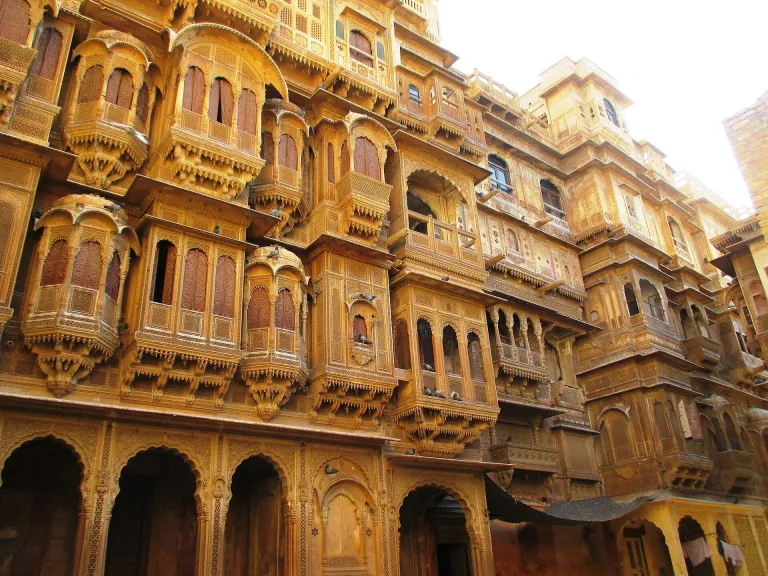
Patwon ki Haveli is not one building but a cluster of five merchant houses standing shoulder to shoulder in a narrow lane north of the fort. Their sandstone fronts are covered in carved balconies, screens and brackets so fine that people often compare them to lace. It is the largest and best known of the Jaisalmer havelis, and the one to choose if you only have time for one.
Who built it
The houses are usually credited to a wealthy Patwa family of traders. The account most often repeated is that a merchant named Guman Chand Patwa began the first house in the early 19th century and that further houses were added for his sons over several decades. Exact dates vary between sources, so treat them as approximate. The family's fortune came from trade in brocade, silver and other goods at a time when Jaisalmer sat on camel caravan routes; the havelis were a very public way of showing that success.
Two tickets, two experiences
This is the part that confuses many visitors. Different houses in the cluster are run by different owners, and they sell separate tickets.
- The private museum haveli, often called Kothari's Patwa Haveli, is the best restored. Its rooms are furnished in period style, with mirror work, painted ceilings, kitchen utensils and costumes. The fee is about ~₹150, with a camera charge of around ~₹50.
- The government-run haveli is plainer inside but cheaper, and its carving is just as good from the outside.
Opening hours are usually about 9:00 AM – 6:00 PM. The facts panel on this page shows the latest figures we hold; check at the door, as both owners adjust prices.
What to see
The lane and the facades
Start in the lane itself. Stand back and look up at the five fronts in a row, then walk slowly along them, noticing how each balcony and window screen differs. The arch at the end of the lane frames the whole group nicely.
Inside the museum haveli
Move from the courtyard up through the floors. Look for the mirror-work room, the painted ceilings and the small displays on merchant life, from turbans to account books. Stairs are steep and narrow, so take your time.
The rooftop
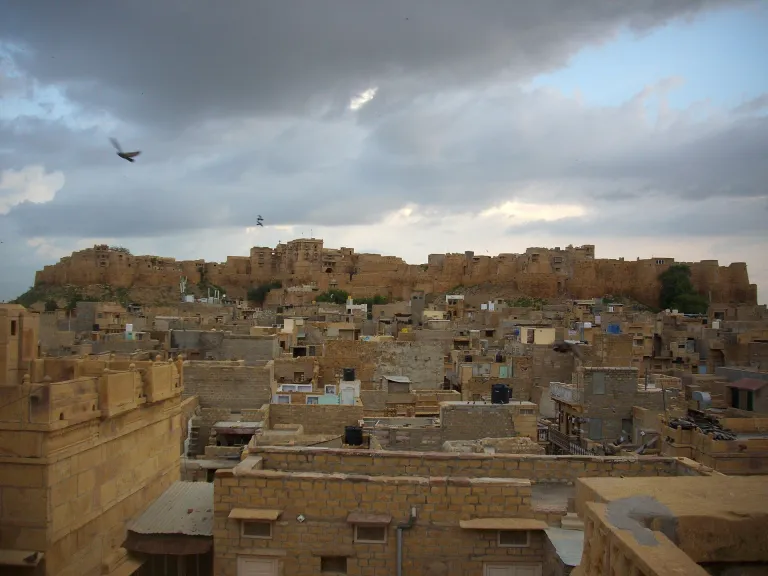
The roof gives one of the better close views of the fort walls rising above the old city. It is a good place to get your bearings before walking on.
Photography and combining
The lane is narrow and shaded for much of the day. Late morning is usually best, when light reaches down onto the upper balconies. Inside, rooms can be dim, so steady your phone against a wall rather than using flash. A wide lens helps in the lane.
Patwon ki Haveli sits within a few minutes' walk of Nathmal ki Haveli and Salim Singh ki Haveli, so most people see all three in one morning. Many start at the fort early, walk down to the havelis before lunch and head to Gadisar Lake later in the day. The itinerary guide lays this out, and sightseeing timings helps you order the stops.
Shops in the lane sell textiles, puppets and silver. Browse happily, but agree prices clearly before buying.
A licensed guide is useful here if you want to understand the symbols in the carving and how the merchant families lived. Without one, take your time on the rooftop and in the courtyard, where the layout of the house explains itself quite well.
Tips for your visit
- Decide beforehand whether you want the furnished museum haveli or the cheaper government-run one.
- Keep your ticket; staff may check it on the upper floors.
- Go in late morning for the best light on the upper balconies.
- The stairs are steep and narrow; this is a harder visit with small children or limited mobility.
- Do not let touts in the lane steer you to a particular shop or ticket.
Tickets & timings
| Place | Indian | Foreign | Camera | Usual hours |
|---|---|---|---|---|
| Patwon ki Haveli The cluster has five havelis. The private museum haveli (Kothari's) and the government-run haveli sell separate tickets; the government one is cheaper (roughly ₹20–30 for Indians, ₹100–150 for foreigners). | ~₹150 | ~₹250 | ~₹50 | about 9:00 AM – 6:00 PM |
Photos
Where it is
~1 km · 5 min from the city. Other places are marked too; tap a pin for details.
The map needs JavaScript. Every place is also listed with its distance from the city.
Map data © OpenStreetMap contributors. Pins are approximate; use your phone map on the road.
Frequently asked questions
What is the entry fee for Patwon ki Haveli?
About ~₹150 for Indian visitors and ~₹250 for foreign visitors, plus roughly ~₹50 for a camera. The cluster has five havelis. The private museum haveli (Kothari's) and the government-run haveli sell separate tickets; the government one is cheaper (roughly ₹20–30 for Indians, ₹100–150 for foreigners).
What are the timings of Patwon ki Haveli?
Usually about 9:00 AM – 6:00 PM. Best time: late morning for light on the facades.
How far is Patwon ki Haveli from Jaisalmer city?
~1 km · 5 min by road. A taxi for the round trip is the easiest option; see cab fares.
How much time do I need at Patwon ki Haveli?
Plan for 1–1.5 hours.
Why are there two different tickets at Patwon ki Haveli?
The five houses have different owners. One is a privately run museum with restored rooms; another is managed by the state. Each sells its own ticket, so you may be asked to pay again if you enter both.
Which part of Patwon ki Haveli is worth paying for?
If you want furnished rooms and displays on merchant life, choose the private museum haveli. If you mainly want to see the carving and the rooftop view on a budget, the government-run house is enough.
How long does a visit take?
About an hour to an hour and a half covers the lane, one haveli interior and the rooftop.
Can I walk there from the fort?
Yes. It is a short walk down from the fort through the old city lanes. Ask for directions to the Patwon lane; everyone knows it.