- Right now
- Open now · closes ~6 pm
- Usual hours
- about 8:00 AM – 6:00 PM
- Tickets
- ~₹20 Indian
~₹100 foreign - Distance
- ~1 km · 5 min
- Time needed
- 45 minutes
- Best time
- Morning
Updated 26 Sep 2026. Times and fees are approximate.
Highlights
- Peacock-shaped brackets
- Blue cupola roof
- Moti Mahal balcony
- Minister's story
The peacock-roofed haveli
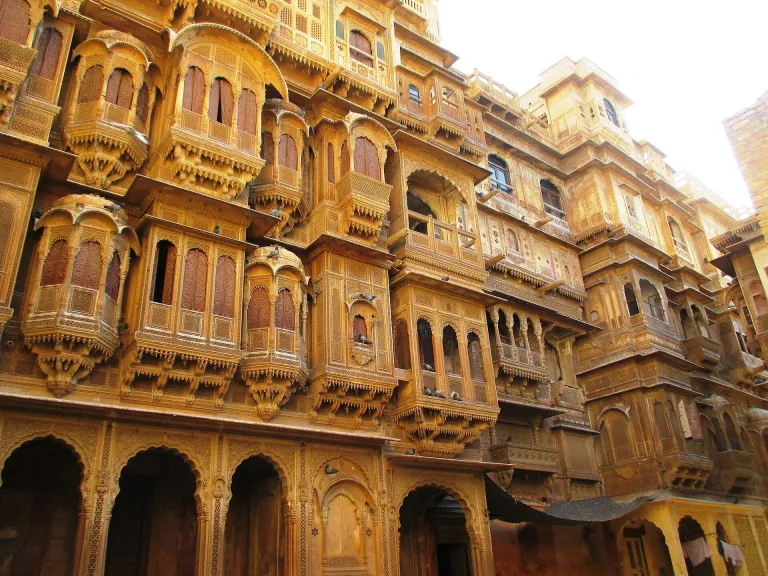
Salim Singh ki Haveli stands near the eastern side of the fort, and you can spot it from a distance by its unusual top floor. The upper storeys flare outwards, supported by carved brackets, and the roof is topped with arched, blue-tinted domes. The brackets are shaped like peacocks, which gives the house its common nickname. Locals sometimes call the top floor Moti Mahal.
The minister and the legend
The haveli is usually dated to around 1815, though some accounts place parts of it earlier, in the 18th century. It is linked to Salim Singh, a powerful prime minister of the Jaisalmer state at the time. Popular stories say he wanted his house to be as tall as the palace in the fort, and that the ruler objected, so the top floors were cut back. Treat this as a story rather than a record.
Salim Singh is also the villain of the best-known local legend. It is said that his demands on the Paliwal Brahmin villagers of Kuldhara and nearby villages drove them to abandon their homes overnight. Historians point to other possible causes, such as heavy taxes, drought and falling trade, so this is a legend rather than settled history. Our Kuldhara story guide looks at the different versions.
What to see
From the lane
Start outside and look up. The contrast between the narrow lower floors and the wide, heavily carved upper storeys is striking. Count the peacock brackets under the overhang and notice how every window and balcony is different.
Inside
The house is privately owned and visitors pay a modest ticket, about ~₹20 for Indian visitors and ~₹100 for foreign visitors, with a camera fee of about ~₹50. It usually opens about 8:00 AM – 6:00 PM. The interior is less restored than the museum at Patwon ki Haveli, but you can climb through several floors and see painted walls and carved rooms. Upper balconies are sometimes closed for repair, so what you can reach may vary.
The view back to the fort
From the higher floors, when open, you get a close view of the fort walls, which helps explain why the height of this house was such a sensitive matter.
Photography and combining
Morning is usually the best time: the light is softer and the lane is quieter. The peacock brackets are high up, so a zoom or a phone with a telephoto lens helps. The lane in front is tight, so step to the side for passing motorbikes.
Salim Singh ki Haveli is close to the fort, and a short walk from Patwon ki Haveli and Nathmal ki Haveli, so most visitors see all three havelis in one morning. If the Kuldhara legend catches your interest, you can drive out to the village later the same day; our itinerary guide shows how to pair it with a desert evening.
Practical notes
The approach is through busy old-city lanes, so walking is easier than trying to bring a car close. Auto-rickshaws can drop you nearby. Inside, floors are uneven and staircases are steep and dark in places, so this visit suits confident walkers better than small children or anyone with limited mobility. There are no cafés in the haveli itself, but plenty of tea stalls and rooftop restaurants a few minutes away.
Because the building is privately owned and ageing, sections may be roped off. That is a sign of repair work rather than anything to worry about. If you want the full background on the ministers, merchants and rulers of the period, a licensed city guide can add a great deal, and our Jaisalmer history guide is a good primer before you go.
Tips for your visit
- Look for the building from a distance first; the flared top floors are easiest to appreciate from afar.
- Visit in the morning for softer light and fewer people in the lane.
- Ask at the door whether the upper floors are open before you pay.
- Bring a zoom lens or use your phone's telephoto setting for the peacock brackets.
- Read the Kuldhara legend beforehand; the visit makes more sense with the story in mind.
Tickets & timings
| Place | Indian | Foreign | Camera | Usual hours |
|---|---|---|---|---|
| Salim Singh ki Haveli Upper balconies may be closed for repair at times. | ~₹20 | ~₹100 | ~₹50 | about 8:00 AM – 6:00 PM |
Where it is
~1 km · 5 min from the city. Other places are marked too; tap a pin for details.
The map needs JavaScript. Every place is also listed with its distance from the city.
Map data © OpenStreetMap contributors. Pins are approximate; use your phone map on the road.
Frequently asked questions
What is the entry fee for Salim Singh ki Haveli?
About ~₹20 for Indian visitors and ~₹100 for foreign visitors, plus roughly ~₹50 for a camera. Upper balconies may be closed for repair at times.
What are the timings of Salim Singh ki Haveli?
Usually about 8:00 AM – 6:00 PM. Best time: morning.
How far is Salim Singh ki Haveli from Jaisalmer city?
~1 km · 5 min by road. A taxi for the round trip is the easiest option; see cab fares.
How much time do I need at Salim Singh ki Haveli?
Plan for 45 minutes.
Why is it called the peacock haveli?
The brackets holding up the upper balconies are carved in the shape of peacocks, and the domed roof adds to the effect. That is where the nickname comes from.
Is Salim Singh really linked to Kuldhara?
In local legend, yes: he is said to have driven the Paliwal villagers away. Historians suggest several other causes, so it is best seen as a legend.
Can I go up to the top floor?
Sometimes. The upper balconies are closed for repair at times, so ask at the entrance before you buy a ticket.